Online Ordering Systems for Restaurants: Real Benefits for Owners


Online Ordering Systems for Restaurants: Owner-Level Benefits You Can No Longer Do Without
For independent restaurants, your online ordering system is now primary infrastructure. The question isn’t whether guests want to order online—it’s whether the system behind that ability functions like how your business actually operates.
When it’s treated as a core operating system, it becomes a tool for control—over demand, labor, revenue, and customer relationships. If online ordering isn’t treated as a bolt-on feature, it introduces friction: overwhelmed kitchens, margin leakage, brand dilution, and zero control when volume spikes.
Below are the problems online ordering systems are meant to solve for today’s operator.
1. Revenue Channel Governance
Restaurants now operate across multiple revenue channels: dine-in, pickup, delivery, catering, pre-orders. Without intentional control systems in place, those channels compete with each other for the same kitchen and staff.
A well-developed online ordering system gives operators authority over how and when orders enter the business. That includes configurable hours, item availability, fulfillment methods, and volume controls. Instead of pure demand dictating operations, operations filter demand.
POS-native OLO platforms like Rezku approach online ordering technology not as a separate funnel—allowing owners to manage all revenue channels inside and outside the restaurant as one holistic system.
2. Labor Optimization, Not Just Labor Cost Reduction
Online ordering isn’t about cutting staff. It’s about protecting attention so they can be used smarter.
Phone calls, handwritten tickets, and ad hoc order handling pull experienced staff away from execution. During peak periods, those interruptions are costly—not just in labor, but in service quality and throughput.
Online ordering systems remove the administrative layer of order taking so staff can stay focused on brining out food, and guest experience. Orders flow directly into the POS. kitchen printers and displays, eliminating re-entry and reducing cognitive load during rushes.
This is less about “doing more with fewer people” and more about letting the right people do the right work by sending the food directly to cooks, who are preparing the meal.
3. Demand Pacing and Kitchen Survivability
One of the fastest ways to break a restaurant is uncontrolled off-premise volume.
Not all online ordering systems give operators tools to manage pacing. Some simply accept demand endlessly, regardless of what the kitchen can handle. That’s not growth—it’s chaos.
Operations-oriented OLO systems allow restaurants to throttle order flow, adjust prep timing, pause ordering without shutting it down entirely, and schedule orders in advance, intelligently. This keeps the kitchen out of the weeds while still capturing off-premise revenue.
Rezku’s online ordering, for example, allows operators to configure hours and pacing rules so online demand aligns with real kitchen capacity—not theoretical volume.
4. Margin Protection in Digital Ordering
Your margins don’t disappear all at once—they leak until there is nothing left.
Commission fees, forced pricing parity, limited upselling tools, and lack of bundling quietly erode profitability when online ordering is outsourced or poorly designed. Even “free” or “included” systems can cost operators if they limit control over menu structure and pricing strategy.
A well-built online ordering system supports: - Bundles and combos - Conditional upsells triggered by guest choices - Highlighting high-margin items - Coupon codes and targeted promotions
These aren’t marketing gimmicks—they’re margin tools. When online ordering lives inside the POS ecosystem, pricing and promotions remain intentional instead of reactive.
5. Menu Strategy Flexibility (Not Just Digitization)
An online menu is not a mirror of the dining room menu—and it shouldn’t be.
Operators need flexibility to design menus that work for off-premise execution: different portions, simplified builds, bundled offers, or limited availability based on fulfillment method. Online ordering systems that lock operators into rigid menu structures limit strategic decision-making.
Modern platforms allow restaurants to:
-
Offer different layouts and formats
-
Use imagery selectively
-
Feature top-performing items
-
Create splash screens or featured sections
Rezku’s online ordering emphasizes visual and structural configurability so operators can design menus that serve operational goals—not just display items.
6. Brand Continuity Beyond the Dining Room
For many guests, the online ordering experience is the brand.
Generic interfaces, inconsistent visuals, and marketplace-driven layouts disconnect the off-premise experience from the restaurant itself. Over time, this weakens brand equity and makes the business interchangeable.
A restaurant-controlled online ordering system allows operators to carry brand identity—colors, imagery, tone—into the digital experience. That continuity reinforces recognition and trust, especially for repeat customers ordering directly from the restaurant’s site.
This isn’t about aesthetics alone. It’s about making sure the restaurant and your hard-won branding efforts remains the focal point.

7. Customer Data That Actually Drives Decisions
Reports are only useful if they teach you something.
Direct online ordering systems capture customer behavior and preferences. Operators gain insight into ordering patterns, popular items, peak times, and repeat behavior—all tied directly to the POS.
When this data stays inside the restaurant’s point of sale platform, it becomes actionable:
-
Better staffing decisions
-
Smarter menu adjustments
-
Targeted promotions instead of blanket discounts
Rezku’s approach keeps online ordering data integrated with the POS, allowing owners to make operational decisions based on reality, not assumptions.
8. Lower Labor Pressure During Peak Hours
Every phone order pulls staff attention away from guests, expo, or the line. During peak periods, that interruption cost compounds quickly.
An online ordering system shifts order entry and payment entirely to the guest, allowing staff to focus on execution instead of transcription. For operators running lean teams, this often becomes the difference between controlled throughput and service breakdown during rushes.
9. Fewer Order Errors and Remakes
Misheard modifiers, rushed confirmations, and handwritten notes are common sources of waste. Every remake costs food, time, and customer goodwill.
Online ordering systems remove interpretation from the process. Guests see the menu exactly as configured, choose modifiers intentionally, and confirm their order before it ever reaches the kitchen. When orders flow directly into the POS and kitchen display system, accuracy improves immediately.
This is especially impactful for restaurants with customizable menus or high modifier volume.
10. Higher Average Order Value Without Staff Pressure
Upselling over the phone is inconsistent and uncomfortable for staff. Online ordering systems handle this automatically and consistently.
Digital menus can popup notifications for upselling add-ons, and upgrades, at the exact moment they make sense—based on what the guest has already selected. When implemented correctly, this increases average order value without slowing service or relying on human judgment.
Operators often discover that online tickets outperform phone orders by a meaningful margin simply because guests have time to explore.
11. Full Control Over Order Flow and Pacing
One of the most overlooked benefits of a restaurant online ordering system is pacing control.
Unlike third-party platforms that prioritize demand at any cost, owner-controlled systems allow restaurants to:
-
Set ordering hours independently from store hours
-
Throttle order volume during peak times
-
Pause or adjust availability without shutting the channel down
This prevents kitchens from getting buried while still capturing off-premise revenue in a controlled way.
12. A Digital Storefront That Reflects the Brand
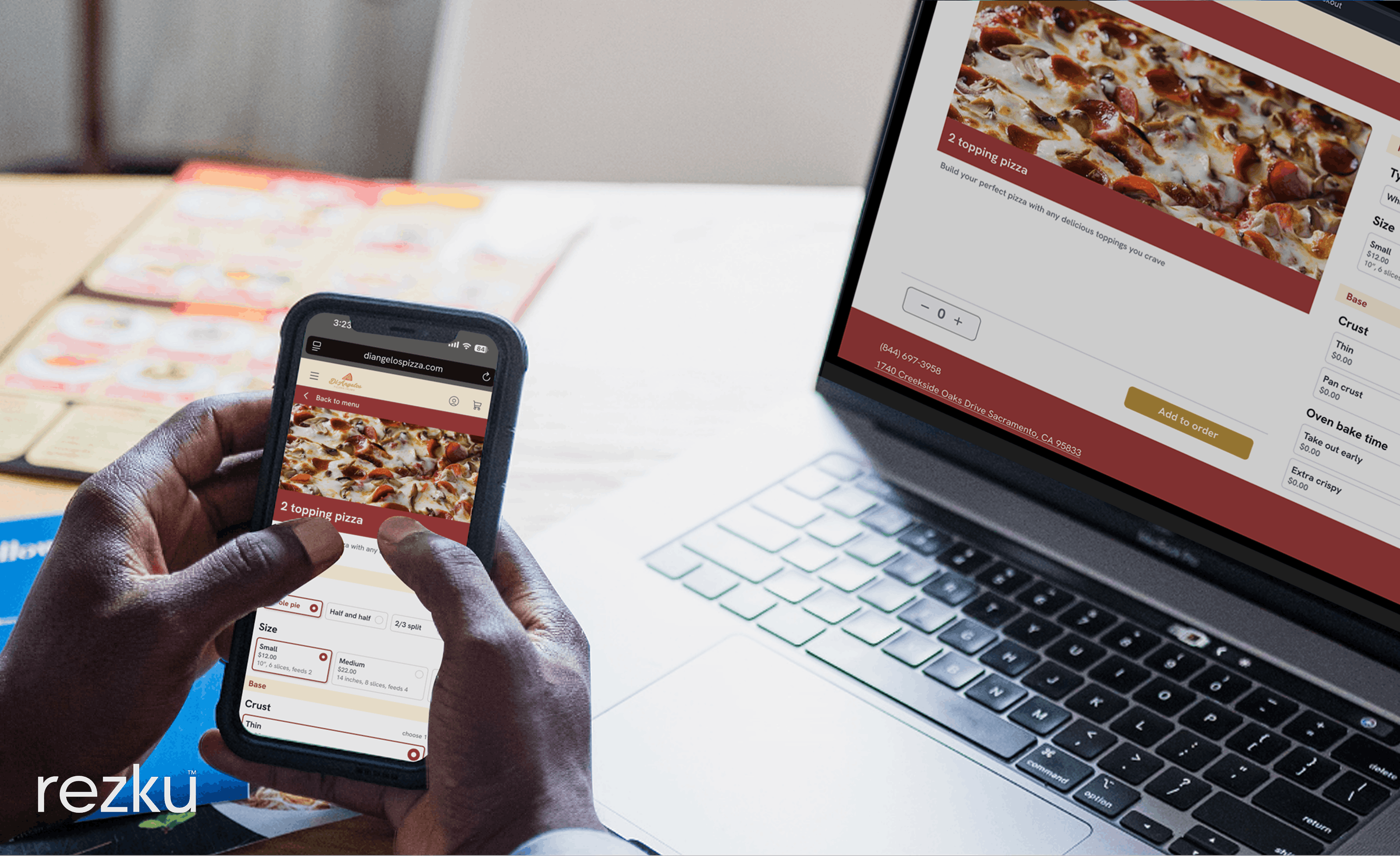
Many “included” online ordering tools are functionally limited and visually generic. For operators who care about brand perception, this matters.
A configurable online ordering system allows restaurants to:
-
Choose layout formats that fit their menu style
-
Use photography strategically
-
Match brand colors and tone
-
Highlight top or signature items
This turns online ordering into an extension of the in-store experience instead of a disconnected utility.
13. Actionable Data Instead of Guesswork
Phone orders and third-party marketplaces provide little usable insight. Direct online ordering systems capture clean data tied to real customer behavior.
Operators gain visibility into:
-
Best-selling items online vs in-store
-
Time-of-day demand patterns
-
Upsell performance
-
Repeat ordering behavior
When this data lives inside the POS ecosystem, it becomes usable for staffing, menu engineering, and promotions—without exporting spreadsheets or reconciling platforms.
14. Ownership of the Customer Relationship
Perhaps the most important long-term benefit: ownership.
When guests order through a restaurant’s own online ordering system, the business—not a marketplace—controls:
-
Customer data
-
Communication
-
Promotions and loyalty
-
The post-order experience
This allows restaurants to build repeat business without paying perpetual commissions or losing visibility into who their customers actually are.
Frequently Asked Questions
What is an online ordering system for restaurants?
It’s a digital platform that allows guests to place pickup or delivery orders directly through a restaurant’s website or branded interface, typically integrated with the POS and kitchen systems.
How is this different from third-party delivery apps?
Third-party platforms prioritize marketplace demand and charge commissions. Direct online ordering systems give restaurants full control over pricing, data, pacing, and customer relationships.
Do online ordering systems increase revenue?
When implemented correctly, they often increase average order value, reduce labor friction, and capture orders that would otherwise be missed—while protecting margins.
Is online ordering expensive to set up?
Costs vary widely. Many modern POS platforms include online ordering as part of the core system, reducing the need for separate vendors or add-on fees.
Do customers expect online ordering now?
For off-premise dining, yes. The expectation isn’t just availability—it’s clarity, speed, and ease of use.
Is online ordering mainly for delivery?
No. Many restaurants use online ordering primarily for pickup, pre-orders, catering, and scheduled orders, where margins and control are strongest.
Can online ordering overwhelm a kitchen?
Yes—if pacing and volume controls are missing. Operator-focused systems include tools to manage order flow intentionally.
Do restaurants need a separate vendor for online ordering?
Not necessarily. Many modern POS platforms, including Rezku, include online ordering as part of the core system to reduce complexity and integration risk.
How does online ordering help margins?
By eliminating commissions, supporting upsells and bundles, reducing errors, and allowing operators to control pricing and promotions directly.
A Practical Next Step
For operators evaluating online ordering systems, the right question is simple: _does this system adapt to how the restaurant runs—or does the restaurant have to adapt to it?
The key question isn’t whether to offer it—it’s whether the system protects margins and kitchen flow. Reviewing how online orders enter the POS, how pacing is controlled, and who owns the customer data will quickly separate surface-level tools from operational assets.
If exploring POS platforms that include configurable, POS-native online ordering, it’s worth reviewing systems designed specifically for independent restaurants rather than marketplace models built around commissions.
Final Thought
Online ordering isn’t about convenience—it’s about control. Restaurants that treat it as infrastructure gain leverage over demand, margins, and operations. Those that treat it as an afterthought inherit new problems along with new orders.
Is Rezku the POS system you’ve been searching for?
Get a custom quote and start your free trial today.
Related Posts