10 Restaurant Technology Trends to for 2026 (and Beyond)

Running a restaurant in 2026 means navigating a landscape that looks very different from just a few years ago. Labor costs are at historic highs. Food costs are volatile. Consumer expectations have been permanently reshaped by digital experiences. And the technology being adopted in the industry is moving faster than ever. Today’s operators are flooded with options that range from genuinely game-changing to completely irrelevant.
This article is not designed to be a list of futuristic concepts. We’ve skipped the drone deliveries and humanoid robots — those headlines are for clicks, not today’s independent restaurants. This is a practical look at the real trends that are delivering measurable results for independent operators right now, with honest takes on what’s worth your time, what’s overhyped, and where Rezku fits in.
1. Automated Loyalty Marketing: The Biggest ROI Most Restaurants Are Leaving on the Table
What’s Happening
Loyalty programs aren’t new. What’s new is the gap between restaurants running them strategically — with automated, behavior-triggered campaigns — and those still blasting generic promotions to their entire email list once a month.
The numbers are stark. Email marketing in the restaurant industry returns approximately $42 for every dollar spent, and SMS open rates in food service exceed 98%, compared to 20–30% for email. Restaurants using automated email campaigns generate 15–25% more repeat visits than those doing manual outreach. Loyalty program members already spend 18–30% more per visit than non-members — the question is whether you’re doing anything to keep them coming back.
The most effective campaigns aren’t “10% off this weekend.” They’re triggered by real guest behavior: a welcome offer sent within hours of a first visit, a win-back message deployed automatically after 45–60 days of silence, a birthday reward that fires a week before the date with a 35% redemption rate on average. SMS win-back campaigns recover around 12% of lapsed guests — three times the rate of email alone.
The National Restaurant Association reports that 61% of limited-service and 52% of full-service operators are now investing in loyalty technology, recognizing that owned guest communication channels are a durable competitive advantage in an era of rising customer acquisition costs.
The Pros
-
Exceptionally high ROI with minimal ongoing labor once set up
-
SMS and email work together — email drives awareness, SMS drives same-day action
-
Behavior-triggered campaigns feel personal, not spammy
-
The average independent restaurant with 500+ guest email addresses leaves $35,000–$60,000 in annual revenue uncaptured by not automating
The Cons
-
Only works if your POS is capturing guest data at the point of sale
-
Requires consistent, clean data — any disconnected systems (POS, online ordering, loyalty) undermines the results
-
Over-messaging is a real risk; exceeding two emails and two texts per week doubles unsubscribe rates
Trend Outlook: 🟢 Accelerating
This is not a trend that will fade. As third-party delivery fees continue to eat into margins, restaurants that build owned relationships with their guests through direct marketing channels have a structural cost advantage. Expect hyper-personalization — recommendations based on past order history and guest preferences — to become the baseline expectation.
How Rezku Helps
Rezku’s automated loyalty promotion system connects directly to your POS data, letting you build behavior-triggered campaigns over SMS and email without needing a separate marketing platform or outside agency. Because loyalty, ordering, and your POS all share the same data, every campaign is targeted by actual purchase history — not guesswork. Rezku also includes a built-in website builder so your loyalty sign-up funnel lives on your own branded property, not a third-party page.
2. Direct Online Ordering: Commission-Free Revenue Is Now the Goal
What’s Happening
The online food ordering market is enormous — estimated at $130.2 billion globally, with projections toward $223.7 billion by 2027. For most restaurants, off-premises dining (takeout and delivery) now accounts for more than half of total traffic. That’s not going backward.
What has changed is where that order comes from. A decisive majority — 67% of consumers prefer ordering from a restaurant’s own website or app over third-party platforms, and 61% of that group say it’s because they want to support the restaurant directly. Customers who place direct orders visit 67% more frequently than guests who don’t order online at all.
The problem is third-party fees. DoorDash, Uber Eats, and Grubhub typically charge 15–30% per order. On a $40 ticket with a 15% food margin, a 25% commission doesn’t just eliminate profit — it creates a loss. Restaurants utilizing independent online ordering solutions report 35% cost savings per order compared to third-party fees, and a 10% increase in overall sales following implementation.
The smart play for 2026 isn’t abandoning third-party platforms — they’re still valuable for discovery. It’s using them for exposure while converting guests to direct ordering relationships wherever possible.
The Pros
-
Commission-free orders dramatically improve per-transaction profitability
-
Direct ordering builds a customer database you own
-
Average digital order value runs 23% higher than in-person transactions
-
25% of consumers spend more on off-premises orders than dine-in
The Cons
-
Requires traffic generation — unlike Uber Eats, you don’t inherit a marketplace audience
-
If your website or ordering experience is clunky, guests will default back to third-party apps
-
Requires investment in packaging and fulfillment to maintain quality
Trend Outlook: 🟢 Strongly Continuing
Direct ordering is a margin issue, and margin pressure isn’t going away. Restaurants that build capable direct digital channels will protect profitability as third-party platforms continue raising fees.
How Rezku Helps
Rezku’s online ordering system plugs directly into your Rezku POS — no manual re-entry, no tablet juggling. Paired with Rezku’s website builder, you get a branded, mobile-optimized ordering experience that you own. Orders flow directly into your kitchen, loyalty data is captured automatically, and you keep every dollar of the margin.
3. Self-Service Kiosks: From Novelty to Expectation
What’s Happening
The tipping point has been crossed. In 2023, 36% of consumers said they wanted more kiosks in the restaurants they visited. By 2025, that figure had risen to 61% — a nearly 25-point jump in two years. Almost half of QSR customers now order from kiosks weekly, and 72% of kiosk users report spending more than they would have at the counter.
The revenue impact is well-documented. McDonald’s reported a 30% increase in average order value after kiosk deployment. PDQ Chicken saw a 25% ticket lift. Across the industry, kiosk orders run 10–30% higher than counter orders — because the system consistently presents upsell prompts without relying on a busy employee to remember.
Beyond revenue, the operational case is compelling. Kiosks reduce total order time by up to 40%, handling multiple simultaneous orders during peak hours without adding labor. They also dramatically reduce order errors — 98% of guests can fully customize their order using kiosks, and every modification is captured accurately.
For independent operators, the math has changed. Early kiosk systems required large upfront investments and complex IT support. Cloud-based kiosk systems have brought both cost and complexity down significantly, making them viable for single-location restaurants for the first time.
The Pros
-
15–30% average ticket lift through consistent, tireless upselling
-
Reduces front-counter labor pressure during peaks without eliminating hospitality roles
-
Dramatically reduces order errors and the waste that comes with them
-
Growing consumer preference — restaurants without kiosks increasingly look dated in QSR contexts
The Cons
-
Upfront hardware cost requires a real ROI calculation for each location
-
Physical layout must be rethought — kiosks placed poorly get ignored
-
Not appropriate for every restaurant type; full-service dining doesn’t need them at the counter
-
Accessibility must be considered — stations need to accommodate all guests
Trend Outlook: 🟢 Accelerating — with caveats
Kiosks are becoming standard in QSR and fast-casual environments. For full-service and independent restaurants, the case depends heavily on volume and layout. This is a trend with clear winners and clear wrong fits — the key is honest self-assessment.
How Rezku Helps
Rezku Kiosk integrates directly with your POS, sending orders straight to the kitchen display system with zero re-entry. Menu updates made in one place reflect everywhere — no more managing separate menus across multiple systems. And because Rezku’s kiosk connects to the loyalty engine, every kiosk order can build the guest profile you’ll use for future automated campaigns.
4. Kitchen Display Systems: The Connective Tissue of a Modern Kitchen
What’s Happening
If there is one technology category where the ROI case for independent restaurants is almost always clear, it’s the Kitchen Display System. The paper ticket is rapidly becoming a liability — slow, error-prone, and impossible to prioritize at volume.
A KDS replaces paper with real-time screens that display, prioritize, and time every order in the kitchen simultaneously. Orders from the dining room, the kiosk, online ordering, and third-party platforms all flow to the same display. Ticket times drop. Order errors drop. The panic of a lost ticket during a Saturday rush disappears.
More importantly in 2026, the KDS has become the hub through which multiple order channels converge. As restaurants take orders from more sources — dine-in, kiosk, direct online, third-party delivery — the kitchen needs a single source of truth. The KDS provides it.
Analytics matter here too. Modern KDS platforms track prep times by station, by dish, by time of day. That data identifies bottlenecks, informs staffing decisions, and helps operators design menus around what their kitchen can actually execute consistently.
The Pros
-
Directly reduces ticket times, order errors, and food waste
-
Connects all order channels into one unified kitchen view
-
Analytics reveal operational bottlenecks you didn’t know existed
-
Relatively low cost compared to most technology investments; high ROI
The Cons
-
Requires staff buy-in and training — resistance is common in established kitchens
-
Screen placement matters enormously; a poorly positioned display is worse than paper
-
Power and connectivity dependencies require backup planning
Trend Outlook: 🟢 Mature and Essential
KDS is no longer a trend — it’s infrastructure. Restaurants still running paper tickets are running an operational handicap. Adoption will continue to grow because the alternative is increasingly unworkable as order channel complexity increases.
How Rezku Helps
Rezku KDS is built into the broader Rezku platform, meaning every order source — dine-in, kiosk, and online — flows to the kitchen display automatically. Color-coding, timers, and customizable station routing keep the line organized during peaks. And because it’s all the same system, ticket data feeds directly into Rezku’s reporting so you can track performance over time.
5. Restaurant Websites as Revenue Infrastructure
What’s Happening
Over 70% of diners check a restaurant’s website before visiting. Nearly 60% prefer to order directly from a restaurant’s website when the experience is good. And yet, many independent restaurants are still running outdated sites — or worse, relying entirely on their Yelp or Google profile as their web presence.
In 2026, your website is not a brochure. It’s the front door to your direct ordering channel, the home of your loyalty sign-up, the primary vehicle for capturing guest data, and the hub of your local SEO presence. Over 90% of restaurant searches have local intent — “burger near me,” “dinner tonight downtown” — and Google’s ranking algorithms increasingly reward businesses with strong, content-rich, mobile-optimized websites.
A restaurant website that doesn’t support direct online ordering is leaving significant revenue on the table. A website that doesn’t capture email addresses or offer loyalty enrollment is leaving a customer acquisition opportunity behind every visit. The data is clear: the most profitable independent restaurants in 2026 are treating their website as revenue infrastructure, not a digital afterthought.
The Pros
-
The single most valuable channel for capturing first-party guest data
-
Supports direct ordering, which carries no commission fees
-
Strong local SEO drives consistent new customer discovery
-
Completely within your control — unlike third-party profiles, your website is your platform
The Cons
-
Requires regular content updates to maintain SEO performance
-
Poor mobile experience is worse than no website — most visitors are on phones
-
Needs integration with ordering and loyalty systems to realize full value; a disconnected site is a missed opportunity
Trend Outlook: 🟢 Non-Negotiable
This is no longer optional. A restaurant without a functional, mobile-optimized, ordering-enabled website is not playing the same game as its competitors.
How Rezku Helps
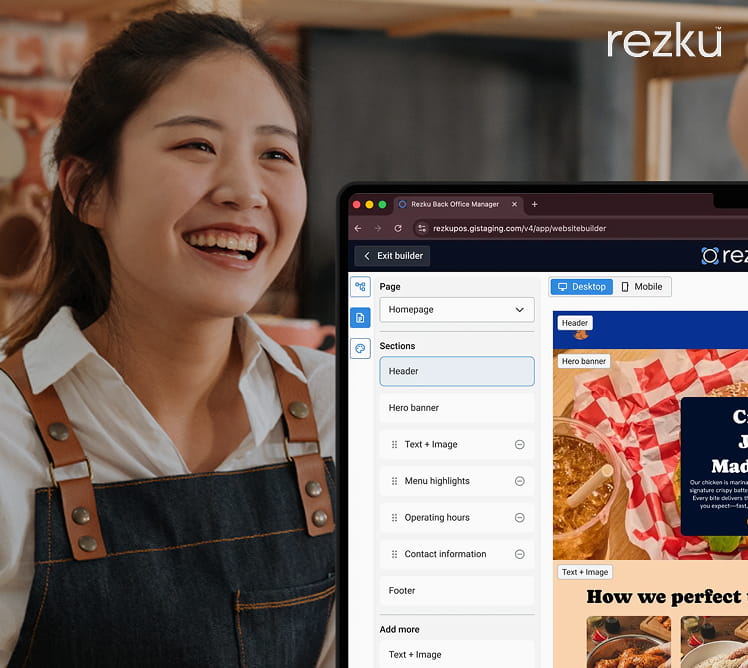
Rezku’s website builder is designed specifically for restaurants — not a generic site builder that requires you to bolt on ordering tools after the fact. Online ordering, loyalty enrollment, and contact information are built in from the start, and everything connects to the same Rezku system running your POS and kitchen. No integrations to manage, no third-party fees for the ordering channel.
6. AI-Powered Business Intelligence: Smarter Decisions Without a Data Team
What’s Happening
“Advanced analytics” used to mean hiring a consultant. In 2026, it means your POS dashboard. Modern restaurant platforms now surface insights that used to require dedicated analysis — food cost percentages in real time, labor efficiency by shift, menu item profitability ranked by margin (not just popularity), and demand forecasting that accounts for day of week, weather, and local events.
In a recent survey of 400 restaurant executives, nearly 39% are already investing in AI and machine learning tools, and 48% plan to adopt them soon. The applications are practical: AI tools that flag over-ordering before it becomes waste, scheduling tools that predict staffing needs based on historical patterns, and reporting that shows which menu items are pulling their weight and which are dead weight consuming prep labor.
For independent operators, the most impactful version of this isn’t some exotic AI platform — it’s a POS system that surfaces the right numbers without requiring a manual deep-dive at the end of every week. Knowing that your Tuesday lunch has a food cost 8 points above average, or that one menu item accounts for 40% of your waste, is the kind of intelligence that changes decisions.
The Pros
-
Replaces intuition-based decisions with data-driven ones
-
Labor forecasting can meaningfully reduce over-scheduling costs
-
Menu engineering driven by actual profitability data (not just sales volume) improves margins
-
Accessible through modern cloud POS platforms — no separate software needed
The Cons
-
Only as good as the data going in — garbage in, garbage out
-
Requires operators and managers to actually review and act on reports
-
Over-reliance on dashboards without operational follow-through produces no value
Trend Outlook: 🟢 Growing Fast
AI will become a practical daily tool for restaurant operators over the next two to three years — not a futuristic concept. The most immediate opportunity is operators who start building consistent data practices now, so their insights improve over time.
How Rezku Helps
Rezku’s reporting and analytics dashboard connects POS, online ordering, and loyalty data in one place, giving independent operators the kind of business intelligence that used to require enterprise platforms. Track food cost percentages, identify high-margin items, and monitor labor performance — all from the same system managing your kitchen and guest relationships.
7. QR Code and Tableside Ordering: The Post-Pandemic Feature That Stuck
What’s Happening
QR code ordering emerged from necessity during the pandemic. What surprised most operators was that a meaningful segment of guests kept preferring it long after restrictions lifted. Today, QR-code menus are used by 58% of restaurants, and a segment of diners — particularly Millennials and Gen Z — genuinely prefer ordering from their phone at the table over flagging down a server.
The operational benefit is real. Tableside digital ordering reduces server steps, captures order accuracy at the source, and enables automatic upsell prompts that don’t require staff to remember to ask. When integrated with a POS, orders from the table flow directly to the KDS without a server as intermediary — which means fewer trips, fewer errors, and tables that can be turned faster.
The caution here is nuance. Not every dining environment benefits from QR ordering, and pushing it on guests who want human interaction undermines the hospitality that brings them back. The most effective operators treat QR ordering as an option, not a mandate — available for guests who prefer it, never a replacement for attentive service.
The Pros
-
Reduces server workload during peaks, allowing smaller teams to cover more tables
-
Order accuracy improves when guests enter their own customizations
-
Integrates with loyalty programs to capture data at the table
-
Low hardware cost — no terminals required
The Cons
-
Guests who prefer human service experience a hospitality deficit if QR is the only option
-
Phone-dependent (battery life, signal) — still requires a fallback
-
Requires a well-designed, mobile-optimized menu experience to work; a bad digital menu is worse than paper
Trend Outlook: 🟡 Stabilizing
QR ordering has found its level — useful in fast-casual and high-volume environments, genuinely valued by a portion of diners across all segments. It won’t disappear, but it’s also not replacing the full-service experience. The trend toward “hospitality-first” technology — where tech serves human connection rather than replacing it — means the restaurants forcing QR-only interactions will see pushback.
How Rezku Helps
Rezku supports QR-based ordering connected to the same POS and KDS system that handles all other order channels. Whether a guest orders at the kiosk, from your website, or by scanning a table QR code, every order flows to the kitchen through the same system — no separate management required.
8. Third-Party Delivery Integration: Controlling the Chaos
What’s Happening
Third-party delivery platforms aren’t going away. Despite the fees, DoorDash, Uber Eats, and Grubhub remain powerful discovery channels — particularly for restaurants without established audiences. The global online food delivery market continuing its march toward $223 billion by 2027 is not a market you can afford to ignore entirely.
The operational problem is the tablet graveyard: three different devices, three separate order streams, three chances for a ticket to be missed or entered incorrectly. Integration tools solve this by funneling all third-party orders directly into a single POS system. The result is one unified workflow for the kitchen, regardless of where the order originated.
The strategic play in 2026 is two-pronged: use third-party platforms for discovery, then systematically convert those customers to direct ordering relationships. Because third-party platforms own the guest data, restaurants that don’t capture those customers through loyalty programs or direct channels are building someone else’s audience.
The Pros
-
Eliminates order entry errors from manual re-entry across multiple tablets
-
Gives kitchen a single queue regardless of order source
-
Centralized reporting lets you compare platform performance and focus energy on what works
The Cons
-
Third-party commission fees remain structurally damaging to margins — 15–30% per order
-
Third-party platforms own the guest relationship; restaurants don’t get the customer’s contact information
-
Heavy third-party dependency is a competitive vulnerability as platforms raise fees
Trend Outlook: 🟡 Necessary but Managed
Third-party delivery will remain part of the mix for most restaurants, but the operators who thrive will be those who treat it as a customer acquisition channel, not a primary revenue channel — and invest in converting those guests to direct relationships.
How Rezku Helps
Rezku’s delivery platform integration pulls orders from DoorDash, Uber Eats, and other third-party platforms directly into your Rezku POS — no separate tablets, no manual re-entry, no missed tickets. Every delivery order enters the same kitchen queue as your dine-in, kiosk, and online orders, giving your team one unified view regardless of where the order came from. And because Rezku’s reporting consolidates all order sources, you can see at a glance which platform is worth the fee and which isn’t pulling its weight — so you can negotiate from a position of data, not guesswork.
9. Contactless Payment and Guest-Facing Payment Technology
What’s Happening
Contactless payment has fully matured from trend to table stakes. Tap-to-pay, mobile wallets, and QR code payment flows are now the standard expectation for most guests — particularly Millennials and Gen Z, who represent an increasingly dominant share of restaurant spending.
The more interesting story in 2026 is what payment integration enables downstream. When payment data connects to your loyalty system, a transaction becomes more than a transaction — it’s a loyalty point accrual, a guest profile data point, and a trigger for post-visit automated communication. Contactless payment that’s integrated with loyalty closes the loop between the dining experience and the guest relationship.
73% of customers now prefer digital receipts, and 88% of high-ticket dining experiences are paid by card. The physical infrastructure question has largely been answered. The opportunity now is in what happens with payment data after the transaction.
The Pros
-
Speeds table turns by 10–15%, meaningful during peak periods
-
Consumer expectation — restaurants that don’t support tap-to-pay are increasingly friction points
-
Payment integration with loyalty enables seamless point accrual without separate sign-in steps
The Cons
-
PCI compliance requirements require ongoing attention
-
Technology and fraud landscape evolves — payment processors require regular security reviews
-
Not all guests want digital receipts or contactless options; printed receipt demand persists (~50%)
Trend Outlook: 🟢 Fully Established
Contactless payment is no longer a trend — it’s infrastructure. The growth opportunity is in the integration layer: connecting payment data to loyalty, marketing, and analytics systems to extract maximum value from each transaction.
10. Staff Technology and Labor Optimization: Doing More with the Team You Have
What’s Happening
Labor remains the defining challenge of restaurant operations in 2026. The National Restaurant Association reports that 77% of operators cite recruiting and retaining employees as a significant challenge, with 98% identifying labor costs as a top concern. Minimum wage increases across multiple states have made the math more urgent than ever.
The technology response isn’t robots — that’s the enterprise story, and the ROI case remains elusive for most independent operators. The real opportunity is in tools that make existing staff more effective: scheduling platforms that use historical POS data to predict staffing needs (reducing over-scheduling), KDS and kiosk systems that let smaller teams handle higher volume, and online ordering that removes the need for a dedicated phone order-taker during peaks.
The human element is critical here. The research is consistent: the primary reason guests choose one restaurant over another remains human connection. The “Hospitality Gap” — the distance between tech-efficient operations and genuine guest experience — is where independent restaurants have a structural advantage over chains. Technology should close operational gaps, not replace the warmth that makes your restaurant worth returning to.
The Pros
-
Scheduling tools backed by POS data reduce over-staffing costs without degrading service
-
Order technology (kiosks, online ordering) absorbs volume without proportional labor increase
-
Freed staff can focus on hospitality rather than mechanical order-taking
The Cons
-
Technology adoption requires training and buy-in — rushed implementation creates the opposite of efficiency
-
Over-reliance on automation in guest-facing roles can hollow out the experience that drives loyalty
-
Labor tools are only as good as the managers who act on the insights they provide
Trend Outlook: 🟢 Growing in Importance
As labor costs continue rising and hiring remains difficult, the restaurants that use technology most intelligently to extend their existing team’s capacity will have a durable operational advantage. This is not about replacing hospitality — it’s about protecting the time and energy to deliver it.
How Rezku Helps
Every Rezku tool — KDS, kiosk, online ordering, loyalty — is designed to reduce repetitive operational burden so your staff can spend less time on mechanical tasks and more time on the interactions that build loyalty. That’s not just a product feature. It’s the design philosophy.
Putting It Together: Your 2026 Tech Roadmap
The operators who get this right don’t try to do everything at once. They identify their biggest operational bottleneck, solve it completely, and move to the next one. Here’s a practical sequence that works for most independent restaurants:
Start with your data foundation. If your POS isn’t capturing guest information at every transaction, none of the downstream technology — loyalty, automated marketing, analytics — reaches its potential. Get that right first.
Add direct online ordering. Commission-free orders are the fastest margin improvement available for most restaurants. Build the direct channel, own the guest relationship.
Activate automated loyalty marketing. Once you’re capturing guest data and processing direct orders, automated SMS and email campaigns turn that data into revenue with minimal ongoing effort.
Add a KDS if you haven’t. Unified kitchen visibility pays for itself quickly in reduced errors and ticket times.
Consider a kiosk if your volume and layout support it. The revenue lift is real, but so is the implementation complexity. Do the honest ROI calculation first.
The goal isn’t to become a tech company. It’s to remove the operational friction that keeps your team from delivering the hospitality your guests come back for. When technology works the way it should, your guests don’t notice it. They just notice that the food came out right, the experience felt smooth, and they want to come back.
Rezku was built by restaurant people, for restaurant people. Our platform combines POS, online ordering, KDS, kiosk, website builder, and automated loyalty marketing into one integrated system — so your data works together instead of sitting in silos. If you’re ready to see how it all connects, we’d love to show you.
Is Rezku the POS system you’ve been searching for?
Get a custom quote and start your free trial today.
Related Posts