Restaurant Customer Service Training That Actually Works: A Realistic Guide for 2026

Let’s start with an honest picture of who you’re probably training.
39.6% of restaurant workers are under 25 years old — compared to 12.9% of the total workforce — and fully 60% are under 35. Younger workers in hospitality increasingly use it as a temporary stepping stone rather than a long-term career path. The restaurant industry’s average annual turnover rate has been 79.6% over the last decade — and it remains higher than pre-pandemic levels. Quick service restaurants typically exceed 130% annual turnover.
None of that means your team can’t be trained to deliver consistently great service. It means your training program has to be built for the actual people you’re hiring — not the idealized version. If your training assumes everyone walks in motivated, career-focused, and naturally inclined toward hospitality, it will fail the first week.
The operators who get this right aren’t necessarily the ones with the best training materials. They’re the ones who’ve accepted that their training program is less of an education system and more of an operational guardrail — a structure that creates consistent outcomes even when the person behind the counter has been on the job for two weeks and still isn’t entirely sure what’s in the soup.
This guide is designed to help you build that structure. We’ll cover what great training looks like across different restaurant concepts, how to calibrate your expectations for the experience levels you’re realistically hiring, and how the right technology reduces your dependence on any single person being exceptional on any given night.
First: What Kind of Restaurant Are You Running?
This is the question that should drive every other training decision — and it’s the one most generic training guides skip entirely. A training program that works for a white tablecloth steakhouse will actively harm an ice cream shop, and vice versa. Before you write a single standard, get clear on your concept and service model.
Fine Dining and Upscale Casual
This is the category where service IS the product — as much as the food. Guests at a $95-per-head restaurant are paying for an experience, and the staff delivering it need to be hospitality professionals in the real sense of the word.
The hiring reality here is different. A seasoned server at a fine dining establishment — someone with years of floor experience, a working knowledge of wine service, the ability to read a table’s mood and adjust their approach accordingly — is not the same as a server at a midscale casual concept. They’ve usually chosen this work deliberately. They have professional pride in it. Training at this level is less about building competency from zero and more about aligning experienced professionals with your specific standards, menu, and culture.
That said, even experienced hires need to be taught your way of doing things. “I’ve been a server for ten years” means they know how to serve; it doesn’t mean they know how to serve at your restaurant. Your training needs to bridge that gap — menu deep-dives, wine and beverage knowledge, your plating philosophy, your approach to service timing — without being condescending to people who’ve been doing this longer than some of your management team.
What great service looks like here: Anticipatory, nearly invisible service. Guests don’t wait for a refill to be offered; it happens before they notice the glass is low. Menus are explained with genuine fluency, not recitation. Problems are resolved calmly and proactively, usually before a guest decides to mention them.
Full Service Casual (the vast middle)
This is where most independent restaurants live: neighborhood spots, family-owned operations, mid-range independents doing $2–8 million in annual revenue. The service model is full-table service — you take orders, you bring food, you handle payments — but the guests aren’t expecting theater.
The hiring reality is mixed. You might have a veteran server who’s worked a section for six years right next to someone who you hired two days ago because you needed a body. Your training has to work for both, which means it has to be structured enough to get the new person functional fast while not being so basic that it insults the people who know what they’re doing.
What great service looks like here: Warm, genuine, efficient. Guests feel welcomed and attended to. Their order is right. If something goes wrong, it gets fixed without drama. The server knows what’s in the food well enough to answer allergy questions confidently. The experience is good enough that people come back.
Fast Casual and Counter Service
The table stakes here have dropped — guests are ordering at a counter or kiosk, food comes out on a tray or in a bag, and “service” is largely defined by speed, accuracy, and the quality of the 45-second interaction at the register.
But “lower stakes” doesn’t mean “no training required.” A rude or confused counter person is just as damaging to your brand as a bad server — possibly more so, because the volume of interactions is higher. You need people who can manage a line, handle substitutions gracefully, and project enough friendliness that the transaction feels human even when it’s quick.
What great service looks like here: Fast, accurate, friendly. The person at the counter knows the menu. They don’t stall or look panicked when someone asks what’s in something. The handoff from order to food is smooth. And when there’s a wait or an error, they handle it without passing it to a manager.
Quick Service and High-Volume (including ice cream shops, fast food, and seasonal/tourist operations)
This is where the workforce reality gets most pronounced. You’re hiring college students, high schoolers, people working a second job, and seasonal workers who may have never worked in any food service setting before. Roughly 27% of food and beverage employees are enrolled in school while working — these are not people building a hospitality career. They’re people earning income between semesters or around class schedules.
Your training program needs to acknowledge this without being dismissive of it. These workers can be great at their jobs — enthusiastic, personable, reliable — but they need extraordinarily clear systems and very little room for ambiguity. “Use your judgment” is not an instruction a first-week ice cream scooper can act on. You have to provide clarity; “When a guest has a complaint about a wrong order, here are the three steps”.
What great service looks like here: Consistent, pleasant, and fast. No confusion. No staff looking at each other blankly when something goes off script. A clean, simple interaction that meets the guest’s expectation.
The Reality of Training the Under-30 Workforce
This section isn’t about complaining about younger workers. It’s about being honest about what research and practical experience tells us about how they respond to training — so you can build something that actually works.
Millennials and Gen Z employees comprise a significant portion of the restaurant workforce and often prioritize flexibility, work-life balance, and career growth opportunities. They’re also, broadly speaking, digital natives who have a low tolerance for processes that feel antiquated, managers who communicate poorly, and jobs that offer no visible path to anything better.
What this means in practice:
They don’t respond well to “sink or swim.” The classic restaurant training model — shadow someone for two shifts, now you’re on your own — worked when servers were career hospitality workers who’d been through it before at other places and understood the general framework. For a 21-year-old who’s never waited tables, being thrown onto a Saturday dinner service after two shadow shifts isn’t a confidence-building challenge. It’s a way to ensure a bad experience for guests, a frustrated new hire, and a two-week employment tenure.
They need to understand the why. “Because that’s how we do it” lands poorly with younger workers. “We confirm allergy requests twice because a wrong answer gets someone hospitalized and costs us everything” lands. The standard doesn’t change — but the explanation should go with it.
They respond to recognition. Teams with structured recognition programs retained hourly workers 15% longer on average. A pre-shift shout-out, a public acknowledgment of a guest compliment, a genuine “you handled that really well” after a rough service — these things matter more than most managers give them credit for.
They’re not necessarily less capable — they’re less experienced. A 22-year-old with good interpersonal instincts and a week of proper training can be a genuinely excellent server. A 22-year-old thrown into a broken system with no training and a manager who’s too busy to help will fail regardless of natural ability.
Stress makes inexperience visible. This is the part where technology matters enormously, and we’ll come back to it. When a new employee encounters a situation they haven’t been trained for — a complicated split check, a delivery driver who says an order doesn’t match what’s on screen, an online order that comes through for something that’s 86’d — their options are either “handle it” or “panic and find a manager.” The less clear and reliable your systems are, the more likely the answer is option two, especially in the first 90 days.
Building a Training Program for Your Restaurant
The best training programs aren’t the most detailed. They’re the most executable — meaning they can actually be delivered in a real restaurant, during real operations, without requiring a full day off the floor or a dedicated HR staff member.
Step One: Write Down Your Standards Before You Train Anyone
You cannot train to a standard that hasn’t been defined. This sounds obvious, and yet most independent restaurants operate on implicit standards — things the owner knows in their head — that never get articulated clearly enough for a new hire to learn from.
Define specifically: - How guests should be greeted (and how quickly) - How your menu should be explained — especially how to handle common allergy questions, dietary restrictions, and “what do you recommend?” - Your service timing expectations — when to check back, when to bring the check, how long is too long for any given moment - What staff are empowered to do without management approval when something goes wrong (comp a soft drink? Replace a wrong order? Offer a discount? Define this clearly) - How to handle a delivery driver pickup, an online order issue, or a POS problem
The last category is the one most restaurants leave out entirely — and it’s the one that causes the most floor chaos. More on that shortly.
Step Two: Front-Load the Essentials
The first 3–7 days before a new hire hits the floor solo should cover:
Menu knowledge. Not memorization — understanding. Staff need to know what’s in the food (allergens especially), what the popular items are, what the best upsell recommendations are, and how to describe the concept’s food honestly and appetizingly. Have them taste it. A server who’s eaten the food can describe it genuinely. One who hasn’t is guessing.
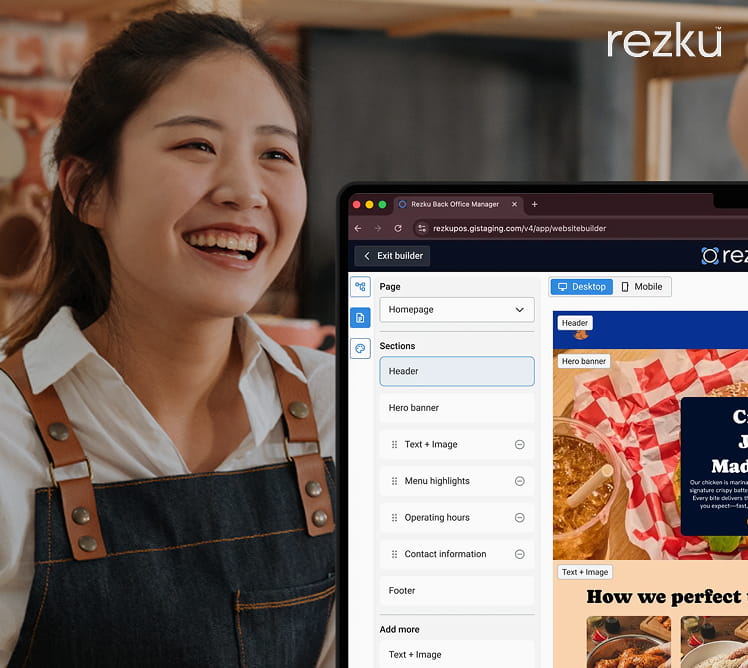
POS basics. This one is non-negotiable regardless of concept. A new hire who freezes at the register during a rush creates a cascade of problems. Walk them through the system until it’s muscle memory — how to enter a basic order, how to add modifiers, how to split a check, how to handle a comped item. This is one of Rezku’s strengths. A powerful POS that’s as easy to use as a smart phone app.
Your service sequence. What happens, in order, from the moment a guest walks in or approaches the counter to the moment they leave. Every concept has a version of this. Write it down. Walk through it.
What to do when things go wrong. This is the training most restaurants skip, and it’s the training that matters most for new, younger, or inexperienced staff. Script it out: If a guest says their food is wrong, here is what you do. If the POS goes down, here is what you do. If a delivery driver says the order isn’t ready, here is what you do.
Step Three: Structured On-Floor Learning
After front-loading, structured floor learning should follow a real progression:
Days 4–14: Active shadowing with a designated trainer (not whoever happens to be on shift). The trainer runs the section; the new hire observes and assists. At the end of each shift, the trainer gives two pieces of specific feedback — one strength, one thing to work on. This doesn’t have to be formal; it has to be consistent.
Days 14–30: Gradual handoff. New hire takes a small section or station during lower-volume services, with the trainer accessible. This is not “you’re on your own” — it’s supervised independence with decreasing intervention as competence builds.
Days 30–90: Reinforcement. Weekly check-ins. Micro-training topics covered in pre-shift — one skill, five minutes, done regularly. Address problems when they’re small, before they become habits.
Step Four: Ongoing Standards Through Pre-Shift
The pre-shift meeting is your most underused training tool. Ten minutes before service, focused on one topic — a common complaint you’ve been seeing, a new menu item, the right way to describe a special — builds cumulative competence without ever requiring you to take the floor offline.
This is also where recognition happens: public acknowledgment of a guest compliment, a shout-out for a team member who handled a difficult situation well. Consistency here matters more than any single training event.
Where Technology Reduces Your Training Burden
Here’s the part most training guides leave out: the right technology doesn’t just support your team — it actually reduces how much your training program has to cover, because it removes the situations where inexperience causes the most damage.
A POS That New Hires Can Actually Learn Quickly
The most common point of failure for new restaurant employees isn’t their attitude toward guests. It’s the register. An outdated, complicated POS system with non-intuitive menu navigation, confusing modifier screens, and no clear workflow is an anxiety machine for someone who’s never used it before — and a source of line backups, wrong orders, and staff frustration that has nothing to do with guest skills.
A modern system like Rezku offers intuitive POS with logical menu structure, clear modifier prompts, and a workflow matches how orders are actually taken, and reduces trainee errors dramatically. New hires learn it faster, make fewer mistakes, and are less prone to getting overwhelmed with the mechanics of the register — which frees up their attention for the guest in front of them.
Reliable Ticket Printing and Kitchen Display Systems
One of the most stressful scenarios for an inexperienced front-of-house employee is the “did my order go through?” moment. When tickets print inconsistently, when the kitchen doesn’t acknowledge orders in any visible way, when a server has no way of knowing whether the modification they entered actually made it to the line — they have to either trust the system or leave the guest and walk back to find out.
A Kitchen Display System connected directly to the POS closes this loop. The order goes in, it appears on the screen, and the BOH confirms it. For a new server learning the floor, this kind of visible confirmation is enormously reassuring — and it prevents the dual problem of servers hovering by the pass to verify their orders and tickets getting lost or ignored.
Third-Party Delivery Integration: Reducing Counter Confusion
One of the most chaotic moments in a modern restaurant — especially for newer staff — is the arrival of a delivery driver. In the old model, this means a third-party tablet running its own orders, printed to a separate receipt, fulfilled from a separate workflow that may or may not be clearly connected to the POS kitchen tickets. The driver says the order is wrong. Or the order was placed for an item that’s 86’d. Or two drivers show up at the same time and the counter person isn’t sure which bag belongs to which.
Native integration with third-party delivery platforms brings all incoming orders — DoorDash, Uber Eats, whatever platforms you use — into the same POS and the same kitchen display. Every order, regardless of source, is handled the same way by the same system. There’s no separate tablet to monitor, no parallel workflow to maintain, no moment where a new employee has to figure out which system has the real order. It’s a meaningful reduction in complexity during a moment that consistently catches inexperienced staff off guard.
Self-Ordering Kiosks: Taking Pressure Off the Counter
For counter-service and fast-casual operations, a self-ordering kiosk does something underappreciated in the context of training: it takes the most basic, high-volume order interactions off your staff’s plate entirely, letting them focus on food preparation, order handoff, and situations that actually require a human decision.
The staff you have left at the counter can focus on quality and exception handling rather than grinding through a line of simple orders. And because kiosk orders flow directly into the POS and KDS alongside counter orders, there’s no parallel management problem for staff to navigate.
Handheld POS Devices: Accuracy Without Extra Steps
For table-service restaurants, handheld ordering eliminates one of the most reliable sources of new-hire error: the walk from the table to the terminal. An order that a new server remembers accurately at the table is sometimes a different order by the time they’ve walked through a busy dining room and waited for a terminal. Entering orders tableside, directly into a handheld, collapses that gap — the order goes straight to the kitchen from the point of capture, and the server’s attention stays at the table where it belongs.
For newly trained staff still building the habit of correct order entry, this also means their manager can see tickets as they come in and catch systematic errors (consistently forgetting to note allergy mods, always missing the second drink, etc.) early in the training arc rather than when a guest complains.
Service Recovery: Training for When Things Go Wrong
Every training program should spend more time on failure scenarios than most do. Things go wrong in restaurants — every shift, at every concept, at every experience level. The question isn’t whether a problem will happen; it’s whether your team knows what to do when it does.
For inexperienced staff especially, an unscripted problem is a crisis. A scripted problem is a procedure.
Train this framework for every customer-facing role:
Listen without interrupting. Let the guest get to the end of their complaint before saying anything. This is harder than it sounds for nervous new hires, who tend to jump in defensively or apologetically before they’ve understood what the actual problem is.
Acknowledge and own it. “I’m sorry, that’s not how that should have arrived” — without blame, without making the guest feel like they’re causing a scene. The specific phrasing matters; train it explicitly.
Offer a solution within your authority. This is where you need to have defined clearly what staff are empowered to do without calling a manager. Replace an item? Yes. Comp a drink? Yes. Issue a full refund? Maybe not without approval. The clearer you are about this in advance, the faster and more confidently your team handles it on the floor.
Follow up. After the issue is resolved, come back. This is the step most people forget and it’s the one that most often converts a frustrated guest into a loyal one. “I just wanted to check back and make sure everything is better now” takes fifteen seconds and lands enormous.
Build these scenarios into your training and role-play them — especially the uncomfortable ones. A guest who insists the food made them sick. A delivery order that’s wrong and the driver has already left. A table that’s waited forty-five minutes and is visibly upset. Running through these in a low-stakes context before they happen in a real service gives your team a framework to fall back on when it matters.
Measuring Whether Training Is Working
Training is an investment, and like any investment, it should be measurable.
The data you need is already in your POS:
Average check size by server. If your upsell training is working, you’ll see it here. A trained server who confidently recommends an appetizer or upsells a bottle of wine will have a consistently higher average ticket than one who just takes the order. Set a benchmark and track it monthly.
Void and comp rates by employee. A high void rate is often a sign of order entry errors — either POS unfamiliarity or inconsistent listening. Track this per employee and use it to target specific training needs.
Ticket times. If a station or server consistently has longer ticket times than peers, investigate whether it’s a floor behavior issue (not picking up food quickly, losing track of tables) or a system issue (unclear KDS priority, printer placement problems).
Beyond the numbers, your online reviews are telling you things about your training program whether you’re reading them or not. Are guests mentioning positive staff interactions by name? Are complaints clustering around the same issues — slow service, wrong orders, unhelpful staff? These are training signals. Read your reviews as training data, not just reputation management.
Conduct brief informal check-ins with newer staff at 30 and 60 days. Ask: - What situations have made you feel unprepared? - What part of the job do you still find stressful? - What would have helped you in your first two weeks?
Their answers will tell you where your training program has gaps — sometimes more honestly than any observation.
A Note on Retention: The Training Investment Only Pays If People Stay
The average cost of employee turnover in the restaurant industry is $5,864 per person when accounting for recruiting, training, lost productivity, and management time. At that rate, a 10-person team with 80% annual turnover costs $46,912 per year just to keep staffed.
Good training reduces turnover — not because employees feel “trained,” but because well-trained employees have more successful shifts. More successful shifts mean more tips, less stress, fewer confrontations with frustrated guests, and a greater sense of competence. Competent people are more likely to stay. Restaurants with internal growth plans saw 20–25% lower turnover.
The connection between training, confidence, performance, retention, and guest satisfaction is a cycle. It starts with the training program, but it reinforces itself through every shift where a prepared, confident team member delivers a good experience and ends their night having done their job well.
That cycle is what you’re building toward. Not a perfect training binder. Not a mandatory seminar. A system that makes it possible for your team to succeed consistently — regardless of how long they’ve been on the job.
Quick Reference: Training Standards by Concept
| Concept | Typical Hire Profile | Core Training Focus | Tech That Helps Most |
|---|---|---|---|
| Fine dining / upscale | Experienced hospitality professionals | Menu mastery, wine knowledge, brand alignment, service timing | Handheld POS, KDS for precision timing |
| Full-service casual | Mixed (veterans + newer hires) | Service sequence, upsell technique, complaint handling | Integrated POS + KDS, handheld ordering |
| Fast casual / counter service | Moderate experience range | Speed, accuracy, menu fluency, line management | Intuitive POS, kiosk to manage line volume |
| QSR / high-volume / seasonal | Mostly first-timers and students | System compliance, scripted service, basic complaint resolution | Simple POS UI, delivery integration, kiosk |
| Bar / nightlife | Experienced bartenders, varied floor staff | Responsible service, high-volume efficiency, upsell on pours | Handheld POS, tab management |
Frequently Asked Questions
How much time should a new server spend training before going solo?
There’s no universal answer — a veteran server moving to a new restaurant needs far less time than someone who’s never waited tables. As a baseline, 3–5 guided shifts covering menu knowledge and the service sequence, followed by a supervised small section during a slower service, is a reasonable minimum for most casual and full-service concepts. Milestones matter more than hours: can they take a table through a full cycle competently? Can they handle a basic complaint without calling for help? Clear those bars before pulling the training wheels off.
What do I do with experienced staff who resist new training?
Get them involved instead of dictating to them. Experienced staff resist training that implies they don’t know what they’re doing. Reframe it: “I’m building this for new hires and I want your input on what actually works.” They become co-authors of the standard instead of subjects of it. This also surfaces institutional knowledge you probably don’t have written down anywhere — which is valuable regardless.
How do I train for delivery order handling?
Start by acknowledging that third-party delivery pickup is one of the most disruptive, under-trained moments in most restaurants. Staff need a clear protocol: where drivers wait, who handles pickup, how to verify an order, what to do when something’s missing or wrong. If your POS integrates natively with delivery platforms, the order flow is simpler to train — it’s the same screen, the same process. If you’re running a separate tablet for each platform, build an explicit protocol and post it somewhere visible near the pickup area.
How do I train staff on the POS quickly?
The best answer is to choose a POS that doesn’t require extensive training to begin with — intuitive menu navigation, logical modifier flow, and clear visual feedback when orders are sent. Beyond that, walk new hires through the system step by step before they’re on the floor, have them enter practice orders during a slow period, and make sure they know the three most common things they’ll do (new order, modifier, split check) before their first real shift. Don’t assume they’ll figure it out. Show them.
What if I don’t have time to train properly?
Then you’re paying for it in errors, comps, slow service, and turnover — just without seeing the line item. The math on replacing a single hourly employee at roughly $2,300 in hard costs typically exceeds the time cost of a proper onboarding program. Find the minimum viable version of structured training — even 30 minutes of pre-floor POS orientation and a printed service sequence checklist is meaningfully better than nothing.
How does Rezku help with training?
Rezku’s POS is designed to be intuitive enough that new hires reach operational competence faster — less time at the register confused means more attention on the guest. Integrated KDS gives BOH and FOH a shared, real-time view of orders so communication doesn’t rely on anyone remembering to check. Native delivery platform integration eliminates the multi-tablet chaos that trips up inexperienced counter staff. And because all of this runs through a single system, your team is learning one workflow, not three.
The right technology doesn’t replace good training — but it makes good training stick. Schedule a free Rezku demo to see how a modern POS supports your team from the first shift.
Is Rezku the POS system you’ve been searching for?
Get a custom quote and start your free trial today.
Related Posts