Stop Paying the Third Party Delivery "Tax": How owning your digital presence changes the math in 2026

It’s 7:00 PM on a Friday. Your kitchen is slammed, the dining room is full, and the tablet in the corner just pinged with another delivery order. On the surface, business is booming.
Then the end-of-month statement arrives. And the reality hits.
That “delivery revenue” on DoorDash or Uber Eats? After commissions, fees, and adjustments, you kept somewhere between 60 and 70 cents of every dollar. If your restaurant does any real delivery volume, you’re likely handing over $30,000 to $80,000 a year to platforms that, in return, give you no customer data, no brand visibility, and no relationship with the person who just ate your food.
The math only gets harder from there. Most restaurants rely almost entirely on third-party apps for off-premises orders because they lack the digital infrastructure to do anything else. Their website is outdated or nonexistent. Their online ordering goes through a platform that charges by the order. Their customer list is an accident, not a system.
In 2026, that approach is a competitive liability. The most profitable independent restaurants have figured out that their website isn’t a digital brochure — it’s the foundation of a revenue system. One that captures guest data, drives commission-free orders, and runs automated marketing in the background while the owner focuses on the food.
This is what that system looks like, why it matters more than ever, and how Rezku makes it accessible to independent operators without a marketing team or an IT department.
The Real Cost of Third-Party Dependency (The Math Has Changed)
Before talking about solutions, it’s worth being clear about what third-party delivery is actually costing you — because most operators are underestimating it.
The advertised commission rates from DoorDash, Uber Eats, and Grubhub run 15–30% per order. But the real cost, once you account for payment processing fees, marketing add-ons, and menu price adjustments needed to stay competitive on the platform, frequently climbs to 30–40% of revenue per order. Industry data confirms this: the effective cost of a third-party delivery order for most restaurants lands closer to one-third of the ticket, not one-fifth.
Run that math on a $45 average order:
- Third-party platform: You keep ~$30. The platform keeps ~$15.
- Your own website with direct ordering: You keep ~$43.65 (after standard payment processing of ~3.9% + $0.50).
Do 50 delivery orders a week through a third-party app and that’s roughly $39,000 per year in commission fees on orders from customers who probably already know you. That number represents real margin — not incremental cost, but money that goes directly to the platform instead of your bottom line.
There’s a subtler problem too. Over 43% of restaurant professionals believe third-party apps interfere with the direct guest relationship — and they’re right. When a customer orders through DoorDash, DoorDash owns that transaction. They own the contact information. They own the order history. They own the ability to market to that guest next time. You fulfilled the food. They got the customer.
The strategic move for 2026 isn’t to abandon third-party platforms entirely. DoorDash controls roughly 56% of the U.S. food delivery market and remains a powerful discovery channel for new customers. The move is to treat third-party platforms as a customer acquisition tool, then convert those guests to your own direct channel as quickly as possible. Every repeat order that runs through your own website instead of an app is margin recovered.
1. Commission-Free Ordering: The Fastest Margin Recovery Available
70% of consumers say they’d rather order directly from a restaurant when they have the option — both because they want their money to go to the restaurant, and because they increasingly trust the pricing clarity of ordering directly.
Restaurants that build capable direct ordering channels see the results quickly. Implementing a native online ordering solution typically produces a 10% increase in overall sales and 35% cost savings per order compared to third-party fulfillment. Customers who place a direct online order with a restaurant visit 67% more frequently than those who don’t order online at all — meaning direct ordering doesn’t just save money on that transaction, it builds the kind of repeat relationship that drives long-term revenue.
The two common objections to direct ordering are worth addressing:
“My customers are used to DoorDash.” They’re used to the convenience of DoorDash. If your direct ordering experience is equally fast and mobile-friendly — and your website is easy to find — most guests who already know you will choose the option that feels like it supports your restaurant. Nearly 70% of customers aged 18–45 use direct ordering channels when they are available and easy to use.
“I’ll lose customers from the apps.” You won’t lose customers — you’ll retain them more efficiently. The play isn’t to pull your listings from delivery platforms. It’s to consistently encourage regulars to order direct: a card in every delivery bag, a loyalty point incentive for direct orders, a “save on fees, order from us directly” note on receipts. These are low-friction tactics that compound over time.
How Rezku Helps
Rezku’s built-in online ordering system sends orders directly to your kitchen display system — no extra tablet, no manual re-entry, no integration headaches. The ordering experience lives on your own website, under your brand. Every direct order builds the guest data profile that powers your marketing. And because Rezku processes direct orders for a flat monthly platform fee rather than a per-order commission, the economics improve with every order you shift from the apps to your own channel.
2. Your Website Is Your Customer Database — If You Build It Right
Here is the most under-appreciated cost of relying on third-party platforms: every guest who orders through DoorDash or Uber Eats is invisible to you. You don’t get their name, email address, phone number, or order history. You can’t follow up. You can’t invite them back. You can’t automate a birthday offer or a win-back campaign. They’re a transaction, not a relationship.
Your own website changes that completely.
When a guest orders through your website, you capture the data that makes every future marketing dollar work harder. That guest’s email and phone number feed into your loyalty system. Their order history tells you what they like. Their visit frequency tells you when to send a win-back offer before they drift away to a competitor.
The downstream value of that data is enormous. Consider what automated marketing can do with it:
- A first-visit follow-up — a thank-you text or email with a bounce-back offer, sent within 24 hours — generates a 6–8% return visit rate within 30 days on its own.
- A 45–60 day win-back campaign triggered automatically for guests who haven’t returned recovers a meaningful percentage of lapsed customers with essentially zero labor.
- A birthday campaign that fires a week before the date sees redemption rates 3x higher than standard promotional emails.
- A VIP segment — your top 10–15% of spenders — can be targeted with exclusive offers that reward loyalty and protect your highest-value relationships.
Restaurants using automated email campaigns generate 15–25% more repeat visits than those doing manual outreach. The combination of email and SMS delivers 2.3x more revenue per campaign than either channel alone.
But none of this works if your website isn’t capturing the guest data in the first place. A website that lacks online ordering, a loyalty sign-up flow, or an email capture mechanism isn’t a revenue asset — it’s a digital brochure that happens to show your hours.
How Rezku Helps
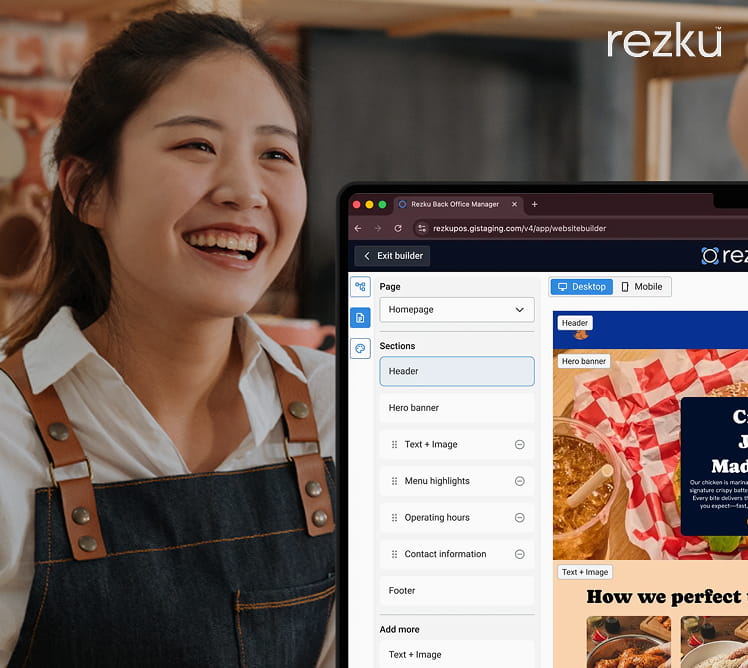
Rezku’s website builder is built specifically for restaurants, with online ordering, loyalty enrollment, and guest data capture woven into the structure from the start — not bolted on afterward. Because the website connects directly to the same Rezku system running your POS and loyalty program, every order and every sign-up automatically builds the guest profile used for automated SMS and email campaigns. One system. No silos. No manual data exports.
3. SEO: The Free Customer Acquisition Channel Most Restaurants Are Ignoring
64% of U.S. diners Google a restaurant before visiting. Nearly all restaurant searches have local intent — someone nearby, deciding right now, searching for “best tacos near me” or “dinner spots open tonight.” Those searches produce a Google Map Pack — the top three results — that captures roughly 80% of all the clicks. The restaurant in position four might as well not exist.
Here’s what determines whether you’re in that Map Pack:
- A complete, optimized Google Business Profile — hours, menu link, photos, attributes, and recent reviews.
- A fast, mobile-optimized website — 90% of restaurant searches happen on mobile. A site that loads slowly or looks broken on a phone is a ranking disadvantage.
- Consistent NAP (Name, Address, Phone) across every listing — Google, Yelp, Apple Maps, TripAdvisor. Even small discrepancies (“St.” vs. “Street”) erode search confidence and hurt rankings.
- Recent reviews and active responses — in the food and dining category, reviews less than two weeks old have the highest influence on local visibility. Hospitality businesses with high-quality photos and a complete profile are 40% more likely to appear in the Map Pack.
- Crawlable menu content — PDF menus are largely invisible to Google. An HTML menu page on your website gives search engines something to index and helps you rank for dish-level searches (“pepperoni pizza downtown Austin”).
In 2026, the SEO landscape has one additional wrinkle worth understanding: Google’s AI Overviews now appear before traditional search results for many restaurant queries, summarizing answers directly on the results page. This means some searchers never click through to a website at all. The restaurant that still wins in that environment is the one whose information — hours, cuisine, atmosphere, price range — is consistent, complete, and up to date everywhere Google looks. A well-built, optimized website remains the foundation of that visibility, even in a world where the first click sometimes goes to an AI summary.
The ROI of strong local SEO is difficult to overstate. 75% of local businesses report that local SEO generates more qualified leads than paid advertising. And unlike a paid ad that stops the moment you stop paying, a well-optimized website and Google Business Profile compound over time.
How Rezku Helps
Rezku’s website builder produces sites with SEO-optimized structure built in — schema markup, mobile responsiveness, fast loading, and HTML menu pages that Google can actually read. For independent restaurants that don’t have a marketing agency or SEO specialist, this means a site that’s doing the right things from day one, without requiring technical expertise to maintain.
4. Brand Control: Your Story, Your Terms
On a third-party app, your restaurant is a logo, a star rating, and a list of items displayed next to 40 competitors in the same cuisine category. The platform controls the layout, the promotions, the recommendations algorithm, and — increasingly — the pricing. You’re a vendor in someone else’s marketplace.
Your own website is the only place where you get to tell your story on your own terms.
That story matters more than most operators think. The research is consistent: guests build stronger loyalty to restaurants they feel a connection with. Your origin story, your sourcing decisions, your chef’s background, your community involvement — these are the details that turn a transaction into a relationship. None of them fit in a DoorDash listing. All of them can live on your website.
There’s a practical operational benefit too: instant menu control. Eighty-six an item at 5 PM before Friday dinner service? Update your website in 30 seconds and it’s gone — no 48-hour support ticket, no guests ordering something you don’t have. Run a weekend special? Launch it Friday morning, retire it Sunday night. Price changes, new photos, seasonal menu refreshes — all of it happens on your timeline, under your control, with no intermediary.
How Rezku Helps
Menu changes made in Rezku propagate automatically across your POS, online ordering, and website simultaneously. You manage one menu in one place, and every customer-facing channel reflects it instantly. No sync lag. No platform-by-platform updates.
5. The Full-Stack Advantage: When Everything Connects
Here is the core problem with the way most independent restaurants have assembled their technology over the past decade: every solution was purchased separately, and none of them talk to each other.
POS from one company. Online ordering from another. A separate email marketing tool. A loyalty app that requires a different login. A website built by a freelancer with no connection to anything else. The result is five systems that create five data silos — and a restaurant owner who spends hours every week trying to reconcile them.
The cost isn’t just the extra administrative time. It’s the fact that disconnected systems make powerful marketing impossible. You can’t run a behavior-triggered loyalty campaign if your POS data is trapped in a system that doesn’t talk to your email platform. You can’t track which online orders came from which marketing campaign if your ordering system doesn’t share data with your analytics. You can’t see your true food cost percentage in real time if inventory and POS aren’t integrated.
This is the structural advantage of a full-stack platform: the data flows automatically from one function to the next, and each tool becomes more powerful because of what it knows about the others.
When a guest places a direct order through your Rezku-powered website, that order:
- Goes directly to your kitchen display system — no re-entry, no delay, no missed ticket
- Builds the guest’s loyalty profile — points accrued, preferences recorded
- Feeds your POS analytics — contributing to food cost tracking, menu performance data, and sales reporting
- Triggers your marketing automation — a first-visit follow-up if they’re new, a win-back timer if they’ve been absent
- Informs your inventory — reducing what needs to be tracked manually
One action. Five systems that benefit. Zero manual work.
That’s not a hypothetical. It’s what Rezku is designed to do — because the alternative (bolting together five separate tools and hoping they integrate) is the version of restaurant technology that costs operators more time and more money than it saves.
What This Looks Like in Practice
Here’s the practical path to building this system without overhauling everything at once:
Step 1: Get a website that actually works. Mobile-optimized, fast, with real HTML menu pages (not a PDF), your Google Business Profile-ready contact information, and a direct ordering link that goes to your channel, not a third-party app. This is the foundation. Everything else builds on it.
Step 2: Launch direct online ordering. The commission savings alone justify the investment quickly. Even shifting 20–30% of your delivery volume from third-party platforms to direct ordering produces meaningful annual margin recovery.
Step 3: Start capturing guest data at every touchpoint. Online orders, kiosk purchases, dine-in visits, loyalty sign-ups through your website. Get the database growing. This is what makes marketing work.
Step 4: Activate automated loyalty campaigns. First-visit follow-ups. Birthday offers. Win-back sequences for guests who haven’t returned in 45–60 days. Set them up once. They run automatically and compound over time.
Step 5: Use your analytics. Which menu items drive the most margin? Which days have the highest delivery volume? Which marketing campaigns drove the most return visits? Let the data inform your decisions instead of guessing.
None of this requires a marketing department. It requires the right platform — one where all of these capabilities are connected by design, not by integration headache.
The Bottom Line
The restaurants that will thrive over the next five years are not necessarily the ones with the best food or the lowest prices. They’re the ones that build a direct, owned relationship with their guests — and use technology to make that relationship more personal, more consistent, and more profitable than what any third-party platform can offer.
Your website is the front door to that relationship. Direct online ordering is how you keep the margin that belongs to you. Automated loyalty marketing is how you convert one-time visitors into regulars without adding labor. And integrated analytics is how you run the whole thing intelligently.
That’s the full stack. And it’s available to independent restaurants today — not as an enterprise solution that requires an IT team, but as a platform built specifically for operators who are focused on running a great restaurant, not managing software vendors.
Frequently Asked Questions
Q: Do I need to drop DoorDash and Uber Eats to benefit from my own restaurant website?
No — and you probably shouldn’t, at least not all at once. Third-party platforms still serve a real purpose: they put your restaurant in front of people who have never heard of you. The strategic move is to use them for new customer discovery, then consistently guide those guests toward ordering directly from your website on repeat visits. Even shifting 20–30% of repeat delivery orders to your own channel produces significant annual margin recovery without abandoning your delivery presence.
Q: How much does a commission-free restaurant website actually save?
It depends on your volume, but the math is straightforward. A restaurant doing 50 delivery orders per week at a $45 average ticket, paying a 25% third-party commission, is spending roughly $29,000 per year in fees on those orders alone. Shifting even half of those to a direct ordering channel — where you pay only standard payment processing of ~2.9% + $0.30 per transaction — recovers approximately $12,000–$14,000 annually in pure margin. Higher volume restaurants see proportionally larger recoveries.
Q: Will customers actually use my website to order, or will they default to the apps?
Most will, if the experience is good. Research consistently shows that 70% of consumers prefer ordering directly from a restaurant when the option is available and easy to use. The key is “available and easy” — a slow, hard-to-navigate, mobile-unfriendly ordering experience will push people back to the apps. A fast, clean, branded ordering page that loads well on a phone and requires minimal steps will convert. The convenience gap between direct ordering and third-party apps has closed considerably in recent years.
Q: How does my restaurant website help with Google search rankings?
Your website is the foundation of your local SEO presence. Google uses it to confirm your business’s relevance, location, cuisine type, and hours — all of which factor into whether you appear in the Map Pack (the top three local results that capture roughly 80% of all clicks). Specific elements that affect rankings include mobile load speed, crawlable HTML menu pages (not PDFs), consistent Name/Address/Phone information, schema markup, and fresh content. A professionally built, SEO-optimized website doesn’t guarantee first position, but the absence of one is almost always a ranking disadvantage.
Q: What’s the difference between a restaurant website with online ordering and just being listed on a delivery app?
Three fundamental differences. First, margin: direct orders keep 95%+ of the revenue; third-party orders keep 60–70% after commissions. Second, data: direct orders capture the guest’s contact information and order history, which powers loyalty programs and automated marketing; third-party orders give you none of that. Third, relationship: when a guest orders through your website, they’re your customer. When they order through DoorDash, they’re DoorDash’s customer — and DoorDash can market to them on behalf of your competitors.
Q: How does Rezku’s website connect to the rest of my restaurant operation?
Rezku is a full-stack platform, which means the website, online ordering, POS, KDS, and loyalty marketing all run on the same system and share the same data. An order placed on your Rezku-powered website flows directly to your kitchen display system, builds the guest’s loyalty profile, contributes to your POS sales data and food cost analytics, and can trigger automated follow-up marketing — all without any manual steps or third-party integrations to manage. This is the core operational advantage over building separate systems that require middleware to communicate.
Q: How quickly can I expect to see results from direct online ordering?
Most restaurants see measurable results within 60–90 days of launching a capable direct ordering channel. The margin savings show up immediately on every order shifted from third-party platforms. Repeat visit rates typically begin improving within the first month once automated post-visit follow-up campaigns are active. SEO improvements — higher local search rankings — are a longer arc, typically showing meaningful movement in three to six months for well-optimized sites. The full compounding effect of owned data, direct ordering, and automated loyalty marketing builds over one to two years.
Rezku was built by restaurant people, for restaurant people. Our platform combines your website, commission-free online ordering, POS, KDS, and automated loyalty marketing (SMS and email) into one connected system — so every guest interaction makes your entire operation smarter. Ready to see the full picture? We’d love to show you what it looks like for your restaurant.
Is Rezku the POS system you’ve been searching for?
Get a custom quote and start your free trial today.
Related Posts