Your Restaurant Competition Has a Marketing Team: Here's How Independent Restaurateurs Level the Playing Field.


Meta Description Independent restaurants are losing ground to chains that outspend them on marketing every day. Here’s the data on why it matters — and how Rezku’s built-in SMS, email, and website tools put a full marketing engine inside your POS.
Here’s something most restaurant owners don’t want to hear: a mediocre burger with a great marketing team will outsell a great burger with no marketing. Every single day.
That’s not cynicism. It’s the actual state of the restaurant industry in 2026, backed by data that’s hard to argue with. Chain restaurant sales grew 3.1% last year while independent restaurants lost more than 9,500 locations — a net decline of 2.3% across the sector. Chains expanded at 1.4% while independents contracted. That gap doesn’t exist because chain food is better. It exists, in large part, because chain restaurants treat marketing as a core business function and most independent operators treat it as an afterthought — or skip it entirely.
This article is a reality check on that imbalance, and a practical guide to closing it.
Breaking The Spell Of The “Build It and They Will Come” Myth
Independent restaurant owners are often extraordinary operators. They understand food, hospitality, sourcing, and service in ways that no corporate handbook captures. What they frequently don’t have is a marketing department — or the time, budget, or tools to function like one.
So most rely on what feels natural: word of mouth, a Facebook page that gets updated occasionally, maybe some Google reviews. The logic is intuitive: if the food is good enough, people will find you.
It’s a comforting idea. It’s also demonstrably false.
A 2024 study found that 65% of consumers say they prefer dining at locally owned restaurants when given the choice. The preference for independents is there — consumers want to support local economies. But preference doesn’t automatically translate to traffic.
Awareness does. Habit does. And both of those are built through consistent, intentional marketing.
The restaurant that reminds a lapsed guest they exist at exactly the right moment gets the reservation. The one that stays quiet loses it to the chain down the street that sent a push notification, a text offer, and a targeted email this week.
What the Competition Is Actually Spending on Marketing
Let’s put some numbers to this, to understand what’ you’re up against.
Major fast-food chains routinely allocate 4–6% of gross revenue to marketing — and that’s not counting the mandatory national advertising funds franchisees pay into. Pizza chains like Papa John’s and Domino’s spend upward of 6% of sales on marketing consistently. Popeyes recently increased its national advertising fund contribution from 4.5% to 5% of sales, with plans to raise it to 5.5%. These brands are spending hundreds of millions of dollars annually to stay top of mind, and in the public eye.
Meanwhile, the average independent restaurant either spends nothing on structured marketing or allocates 1–2% of revenue — and much of that goes toward one-time costs like menus or signage rather than ongoing customer engagement.
The result is a structural awareness gap that compounds over time. Chain customers get loyalty app notifications, targeted email offers, SMS deals, and retargeted ads on social media. Independent restaurant guests get… whatever happens to come up on their feed.
And here’s the compounding problem: the chains aren’t just outspending you on advertising — they’re out-retaining you on loyalty. Restaurant loyalty program members visit 20% more frequently and spend 20% more per visit than non-members. Chains have entire teams dedicated to this.
You have a to-do list that’s already too long.
The Data on What Actually Moves the Needle
Before we talk tools, it’s worth grounding the conversation in what restaurant marketing channels actually deliver — because the ROI differences between them are dramatic.
Email Marketing
Email is the highest-ROI digital marketing channel available to restaurants — by a wide margin.
- Email marketing returns approximately $42 for every $1 spent — a 4,200% ROI
- For context, Facebook advertising returns roughly $4–5 per dollar spent — about 10x less effective
- Automated email campaigns drive an average of $96 in revenue per click and create a 247% increase in repeat diners
- Restaurant email campaigns average open rates of up to 43%, with welcome emails opening at 91%
- 55% of diners say they are influenced by quality promotional emails from restaurants
- Nearly 60% of customers say they joined a restaurant’s email list specifically to receive exclusive discounts and deals
The catch: most restaurants capture fewer than 15% of guest emails and send generic monthly blasts to stale lists. The ROI potential is enormous, but it’s dependent on having the guest data and automation infrastructure to use email intelligently.
SMS Marketing
Text marketing is newer for most restaurants, but the engagement numbers are hard to argue with.
- SMS messages have a 98% open rate — compared to ~37% for email
- 81% of consumers check their texts within 5 minutes of receiving a message
- SMS campaigns see click-through rates between 19% and 36%
- Texted coupons are redeemed 10 times more often than traditional coupons
- Restaurant SMS campaigns have contributed 10–20% of total monthly sales when used consistently
- Businesses using text marketing are 683% more likely to report digital marketing success than those that don’t
SMS is a different tool than email — it’s best for time-sensitive, high-urgency communication. A slow Tuesday night. A new menu item dropping this weekend. A loyalty reward that expires in 48 hours. Done right, a single text can fill seats the same evening it’s sent.
Your Restaurant Website Is A Revenue Center
This one doesn’t get the attention it deserves. In the rush to manage social media and online ordering platforms, the restaurant website often becomes an afterthought — or it’s a static page from years ago that doesn’t rank, doesn’t convert, and doesn’t represent the restaurant well.
That’s a significant problem for one simple reason: your website is your only marketing channel that you fully own and control. Social media platforms change their algorithms. Third-party delivery platforms charge commissions on every order. Email and SMS require subscribers you’ve built over time. But a well-built, SEO-optimized restaurant website generates discovery traffic — people searching for restaurants like yours, in your area. And your website converts that web traffic into reservations and orders, for free, indefinitely.
Consider what that increased web traffic is worth:
- More than 70% of diners use online ordering methods
- 90% of restaurants on review platforms like Yelp see direct traffic from web searches
- A website that converts discovery traffic into direct online orders eliminates third-party commissions entirely — typically 15–30% per order on platforms like DoorDash or Grubhub
A restaurant that generates even $3,000 per month in direct online orders through its own website vs. a third-party platform is keeping $450–$900 in commissions that would otherwise go to the platform. Over a year, that’s thousands. Real money.
Why Most Independent Restaurants Don’t Do Any of This
The honest answer is not laziness. It’s that the tools haven’t been available in a form that’s practical for a restaurant operator to actually use.
Doing email marketing “right” has historically meant subscribing to a do it yourself email marketing platform, manually exporting customer data from your POS, building segments, designing templates, and figuring out automation triggers — none of which are intuitive to someone whose primary skill is running restaurant operations.
And then you have SMS marketing, which has meant a separate subscription to a texting platform, a separate list, separate compliance requirements, and more manual effort to keep everything in sync.
Building a restaurant website has meant hiring a developer or agency, paying $1,000–$3,000+ upfront, and then waiting weeks before seeing anything — not counting the ongoing cost of hosting, updates, and maintenance.
And all of this assumes you have time to learn and manage three separate tools on top of everything else. For most independent operators, that’s the real barrier: not budget, and not willingness, but bandwidth.
What Rezku Includes, To Launch Your New Restaurant Marketing Plan
This is the gap Rezku is designed to close. Instead of forcing restaurant operators to stitch together separate tools for POS, online ordering, marketing, and web presence, Rezku builds them together — so the guest data from your POS powers your marketing automatically, and your marketing connects back to online ordering and loyalty without manual effort.
Here’s what’s included:
Automated SMS and Email Marketing
Rezku’s built-in marketing tools let you run the kinds of campaigns that chains spend six figures building — from inside your POS, without a marketing team.
Automated SMS campaigns let you reach guests directly on their phones with targeted messages tied to real behavior: a win-back text when someone hasn’t visited in 30 days, a loyalty milestone notification when they’re close to a reward, a flash offer to fill a slow night.
Automated email campaigns work the same way — triggered by visit data from the POS, personalized by guest history, and sent at the right moment without any manual scheduling. The same guest data that drives your reporting drives your marketing.
Because everything is connected to your POS, you’re not importing and exporting spreadsheets between systems. The list builds itself as guests come in, orders are placed, and loyalty is earned.
An SEO-Optimized Restaurant Website
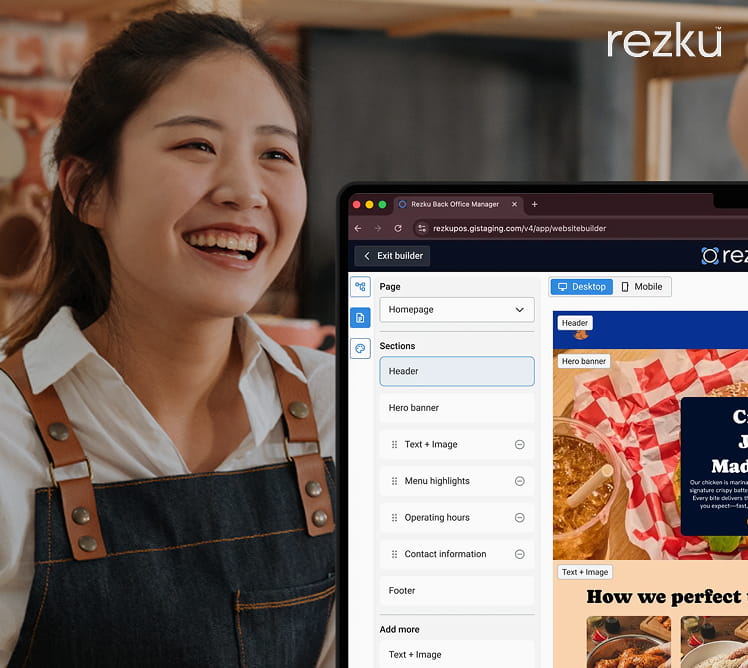
Rezku’s website builder is built specifically for restaurant operators — not a generic tool adapted for something else, but a purpose-built solution with SEO optimization baked in from the start.
Your website connects directly to your online ordering system, so the traffic your site generates converts into direct orders. Not third-party platform orders with a commission attached. Direct orders, at full margin, through a site you own.
The setup is handled as part of Rezku’s onboarding process — not an extra project you have to manage separately. You describe what you need, and the team builds it. Menu updates push automatically. You maintain control without needing a developer on speed dial.
Loyalty That Connects to Everything
Loyalty programs work best when they’re seamlessly connected to marketing. Most restaurant loyalty tools operate in a silo — points accumulate, but the restaurant has no automated way to remind guests about their rewards, push them toward a milestone, or re-engage them when they go quiet.
Rezku’s loyalty is integrated with the same guest data that drives SMS and email, so the marketing and the rewards reinforce each other automatically. A guest earns a reward — they get a text. A loyalty member hasn’t visited in six weeks — they get an email with a personalized offer. The system runs in the background while you focus on service.
How Rezku Compares to Other Restaurant POS Systems
Most POS platforms acknowledge marketing as important and then bolt on third-party integrations that still require you to manage the connection, maintain the data, and do the work. Here’s an honest look at how the major players stack up on the features that matter for independent restaurant marketing:
| Feature | Rezku | Toast | Square | SpotOn | Clover |
|---|---|---|---|---|---|
| Built-in email marketing | ✅ Native | ⚠️ Add-on via Toast Marketing | ⚠️ Add-on (Square Marketing) | ⚠️ Add-on (paid) | ❌ Third-party only |
| Built-in SMS marketing | ✅ Native | ⚠️ Add-on via Toast Marketing | ❌ Third-party only | ❌ Third-party only | ❌ Third-party only |
| Restaurant website builder | ✅ Included, SEO-optimized | ⚠️ Available at additional cost | ❌ No | ⚠️ Add-on ($90/month) | ❌ No |
| Website connects to online ordering | ✅ Yes, direct | ⚠️ Yes, with setup | ❌ No | ⚠️ Partial | ❌ No |
| Marketing tied to POS guest data | ✅ Native integration | ⚠️ Partial, requires setup | ⚠️ Partial | ⚠️ Partial | ❌ No |
| Loyalty integrated with marketing | ✅ Yes | ⚠️ Separate module | ⚠️ Separate module | ⚠️ Add-on | ⚠️ Via apps |
| Commission-free online ordering | ✅ Yes | ✅ Yes | ⚠️ Add-on | ✅ Yes | ❌ No |
| Setup and training included | ✅ No extra cost | ❌ Paid ($0–$500+) | ❌ Self-serve | ❌ $1,000 setup fee | ❌ Varies by reseller |
| US-based support | ✅ Included | ⚠️ Mixed reviews | ⚠️ Limited hours | ⚠️ Inconsistent | ⚠️ Via reseller |
Feature availability and pricing based on publicly available information as of 2026. Contact individual providers for current quotes.
The practical difference: on most other platforms, getting email marketing, SMS, a website, and loyalty all working together means paying for at least 2–3 additional subscriptions, managing separate logins, and maintaining the data connections between them yourself. That’s a part-time job most independent operators don’t have the bandwidth to take on.
On Rezku, it’s all one system, one dashboard, one data set — and when something isn’t working, one phone call to a US-based support team that includes setup and training at no extra cost.
What Modern Restaurant Marketing Actually Looks Like in Practice
To make this concrete, here’s what the week-to-week reality looks like for a Rezku customer using these features:
Monday morning: An automated email goes out to 85 guests who haven’t visited in 45 days. The subject line uses their first name and references their most recent visit. About 12% open it, and 8 of them make reservations or place online orders by the end of the week.
Wednesday afternoon: A slow dinner service is coming — it’s raining, the midweek lull is real. A 30-second SMS blast goes to opted-in guests: “Rainy night special: 15% off dine-in tonight only. Show this text to your server.” By 6pm, three tables that wouldn’t have been there walk in.
Friday: A guest reaches 500 loyalty points. An automated text fires instantly: “Congrats, you’ve earned a free dessert — redeem it on your next visit.” She’s back the following Tuesday.
Meanwhile, ongoing: The restaurant’s website is appearing in local search results for “Italian restaurant [city name] dinner” — not because of any ongoing effort, but because the SEO structure is built in from the start. Online orders through the site generate no commission. That’s every dollar of those orders staying in the business.
None of this required a marketing hire, a separate software subscription, or hours of setup work. It’s running in the background while the owner focuses on what they do best.
The Real Cost of Doing Nothing
Marketing inaction has a direct dollar cost that’s easy to underestimate because it shows up as missing revenue, not as an expense line.
Consider: acquiring a new restaurant customer costs 5–7 times more than retaining an existing one. Existing customers spend an average of 67% more per order than first-time guests. And 70% of first-time diners never return — not because of a bad experience, but because nobody followed up.
If your average guest spends $40 per visit and visits 8 times per year, they’re worth $320 annually. If a simple, automated email or text campaign brings back even 10% of lapsed guests per month, and you have 500 lapsed guests in your database — that’s 50 additional visits, $2,000 in monthly revenue, that wouldn’t have happened otherwise.
The chains do this math constantly. They run win-back campaigns, loyalty nudges, and seasonal promotions with the precision of a revenue science team, because they have one.
The good news for independent operators is that the tools to do this are no longer reserved for brands with marketing departments. They’re inside Rezku, ready to run.
Frequently Asked Questions
Do I need marketing experience to use Rezku’s marketing tools?
No. The system is designed for restaurant operators, not marketers. Campaigns are template-based, automation is pre-configured for common restaurant scenarios like win-backs and loyalty milestones, and the Rezku team walks you through setup at no additional cost. If you can describe what you want to communicate to guests, the tools handle the execution.
How does Rezku build my email and SMS list?
Your guest list builds automatically through the POS — every loyalty signup, online order, and reservation adds a contactable guest to your database. No manual data entry, no CSV exports, no list maintenance. The list grows with your business.
Is the website Rezku builds actually optimized for search?
Yes. The restaurant website included with Rezku is structured for local SEO from the ground up — meaning it’s built to appear when people in your area search for the type of food you serve. This is different from a generic website builder where SEO is an optional add-on. Menu updates push automatically so your site is always current, which also helps search ranking.
How is this different from just signing up for Mailchimp and a texting app separately?
The fundamental difference is data. A standalone email platform like Mailchimp doesn’t know when your guests visited, what they ordered, how many loyalty points they have, or when they last ordered online. So your campaigns have to be generic. Rezku’s marketing is powered by your actual POS data, which means campaigns can be personalized and triggered by real behavior — the kind of targeting that actually drives results.
Does Rezku charge extra for marketing features?
No. SMS marketing, email marketing, and the restaurant website builder are included as part of Rezku’s platform. There’s no separate “marketing add-on” to activate and pay for separately. Setup and training are also included at no extra cost.
How do I get guests to opt in to texts and emails?
Opt-in happens naturally through the guest experience — loyalty signups at the counter, online ordering flow, reservations, and your website. Rezku makes it easy to present the opt-in at the right moment in the guest journey. Because the value proposition is clear (exclusive offers, loyalty updates, first access to new menu items), guests opt in willingly.
What’s the minimum size restaurant that makes sense for this?
Any restaurant that has repeat guests — which is virtually every restaurant — benefits from automated marketing. Even a single-location independent with 100 regular guests has a meaningful opportunity to increase visit frequency and average spend through targeted follow-up. The tools scale from a single-location neighborhood spot to a multi-unit operation.
Want to see Rezku’s marketing tools in action? Schedule a free demo and we’ll show you exactly what automated SMS, email, and your own SEO-optimized website would look like for your restaurant.
Is Rezku the POS system you’ve been searching for?
Get a custom quote and start your free trial today.
Related Posts